
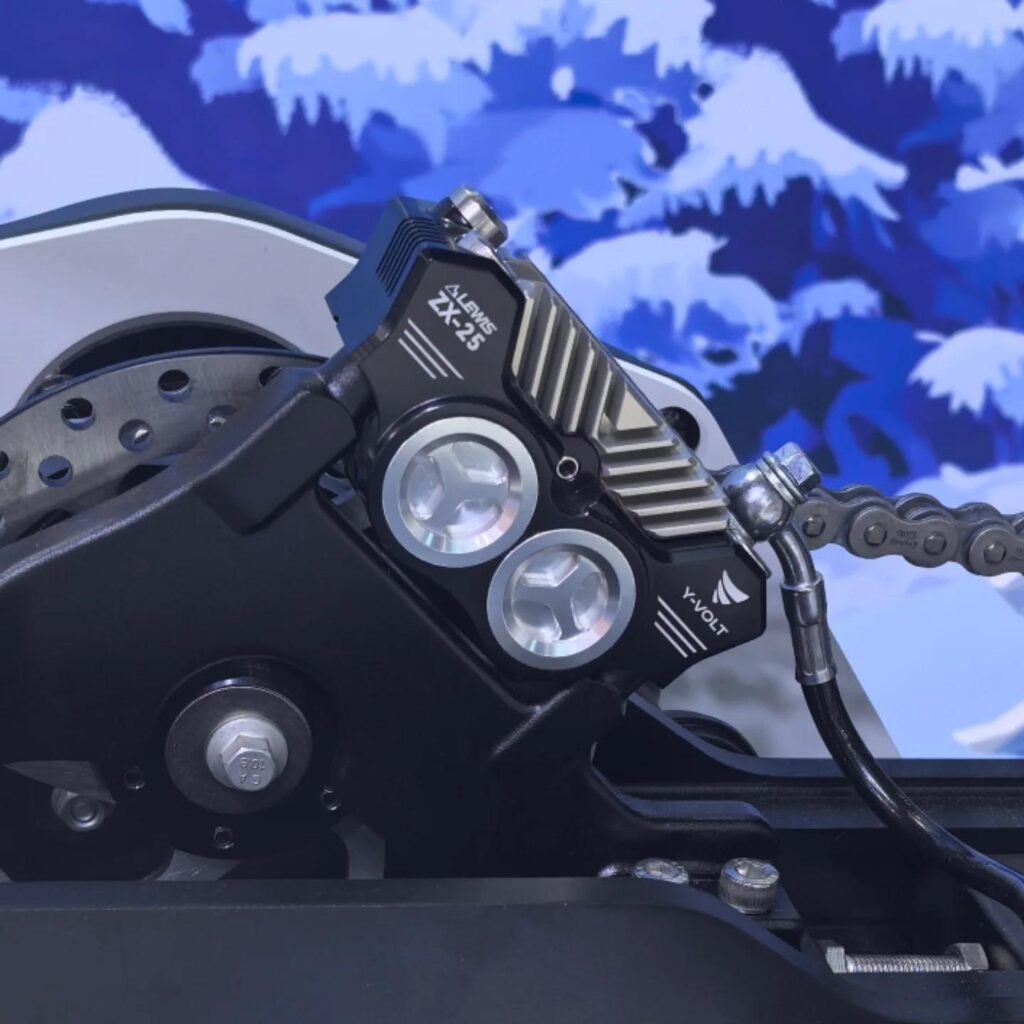
Eight in the morning, first groom of the day. The surface is a hard shell of packed snow. The fat bike’s 4.8-inch tires are aired down to 4 psi — a contact patch the size of your palm, and it looks like infinite grip. Then you ride it, and it feels like stepping onto greased glass.
You start the descent and squeeze the lever. Nothing for a second. Then it locks and slides out from under you. As you go down, the thought isn’t “I’m not good enough for this.” It’s “how does a brake behave like this?”
The problem isn’t the rider. It isn’t entirely the tire either. The problem is that most mountain brakes were designed for dry dirt — and snow is a different physics problem.
Four things snow does to a brake
One: cold. Fluid viscosity shifts as temperatures drop. Seal elasticity slows, so pistons return later. Trace moisture in the line can crystallize overnight. The same brake that feels crisp in a 20 °C workshop turns sluggish at −8 °C — late to return, prone to dragging, sometimes refusing to come back at all after a squeeze.
Two: the lock-up window is razor thin. The friction coefficient of snow, ice, and packed crust runs roughly a tenth of dry asphalt. A fat bike is a large-contact-patch, low-rpm, high-torque system to begin with — there was never much grip margin to spend. So the usable braking stroke collapses into a slit: a little less and you don’t stop, a little more and you slide. What keeps you upright here isn’t peak power. It’s whether that slit is wide enough to find, and predictable enough to trust.
Three: contamination and wear. Slush, road salt, and ice grit work their way between pad and rotor continuously. Wear rates run several times higher than on dirt, and it comes with noise, drifting bite points, and a within-day fade — fine in the morning, soft by afternoon.
Four: the thermal model breaks down. Long snow descents are low speed, long duration. Riders drag the brake lightly for minutes at a time; heat accumulates continuously. But airspeed is low, ambient temperature is low, and half the rotor is buried in snow spray. Heat generation is continuous. Heat dissipation is not. That’s a duty cycle specific to snow, and general-purpose brakes were never calibrated against it.
Why a trail brake “changes character” out here
It isn’t short on power. It’s calibrated against the wrong reference.
Mainstream disc brakes put the bite point early and keep the linear range narrow, so that on dry dirt you get instant response. On snow, that same logic becomes a liability. Generous dead stroke means that with thick gloves and cold, stiff fingers, hitting the exact “just short of locking” position is a precision task you can’t reliably perform. Piston return depends on seal deformation, and at low temperature that deformation is slower — pad-to-rotor clearance doesn’t restore in time, and you get drag. Pad compounds usually prioritize dry-condition durability, and their wear curve turns sharply upward once snow water and abrasive grit are in the mix.
Put simply: the brake isn’t bad. It was tuned for a different world.
What ZX does differently: predictability before peak force
The design intent fits in one sentence — on a surface where grip is wildly inconsistent, a predictable force is worth more than a bigger one.
- Stroke traded for precision.Through [leverage ratio / bite point position], the effective braking stroke is lengthened so that the “enough, but not locked” zone occupies a wider tolerance window. On snow you don’t want a harder brake. You want a longer adjustable range.
- A stable bite point and a tighter dead stroke.[Dead stroke value] is reduced and paired with [tool-free bite point adjustment], so a rider in thick gloves, with fingers that aren’t working precisely, still lands the right pressure on the first squeeze.
- Return and sealing built for cold.[Seal material / cold-weather return structure] compensates for delayed rebound at low temperature, heading off the drag that comes from a piston that won’t retract — the most easily overlooked failure mode on snow, and the one that hits both range and safety hardest.
- A friction interface that resists contamination.Sintered metal pads plus [rotor clearance design / mud-shedding structure] give slush somewhere to go instead of grinding it repeatedly across the friction surface, flattening that within-day fade.
- Thermal design for low-speed, long-duration drag.[Piston spec / heat dissipation structure] is calibrated for sustained low-power work, not short high-intensity stabs. That’s the most fundamental difference between snow and dirt.
The conclusion
What a wheeled snow bike actually needs isn’t a stronger brake. It needs a brake that knows it’s on snow — one that doesn’t lag in the cold, doesn’t drift when it’s dirty, doesn’t go soft after minutes of light drag, and above all, in the one second when your fingers are least responsive and the grip is worst, delivers exactly the force you asked for.
ZX doesn’t solve “can I stop.” It solves “does it stop the same way every single time.” On snow, the second one is what safety means.